
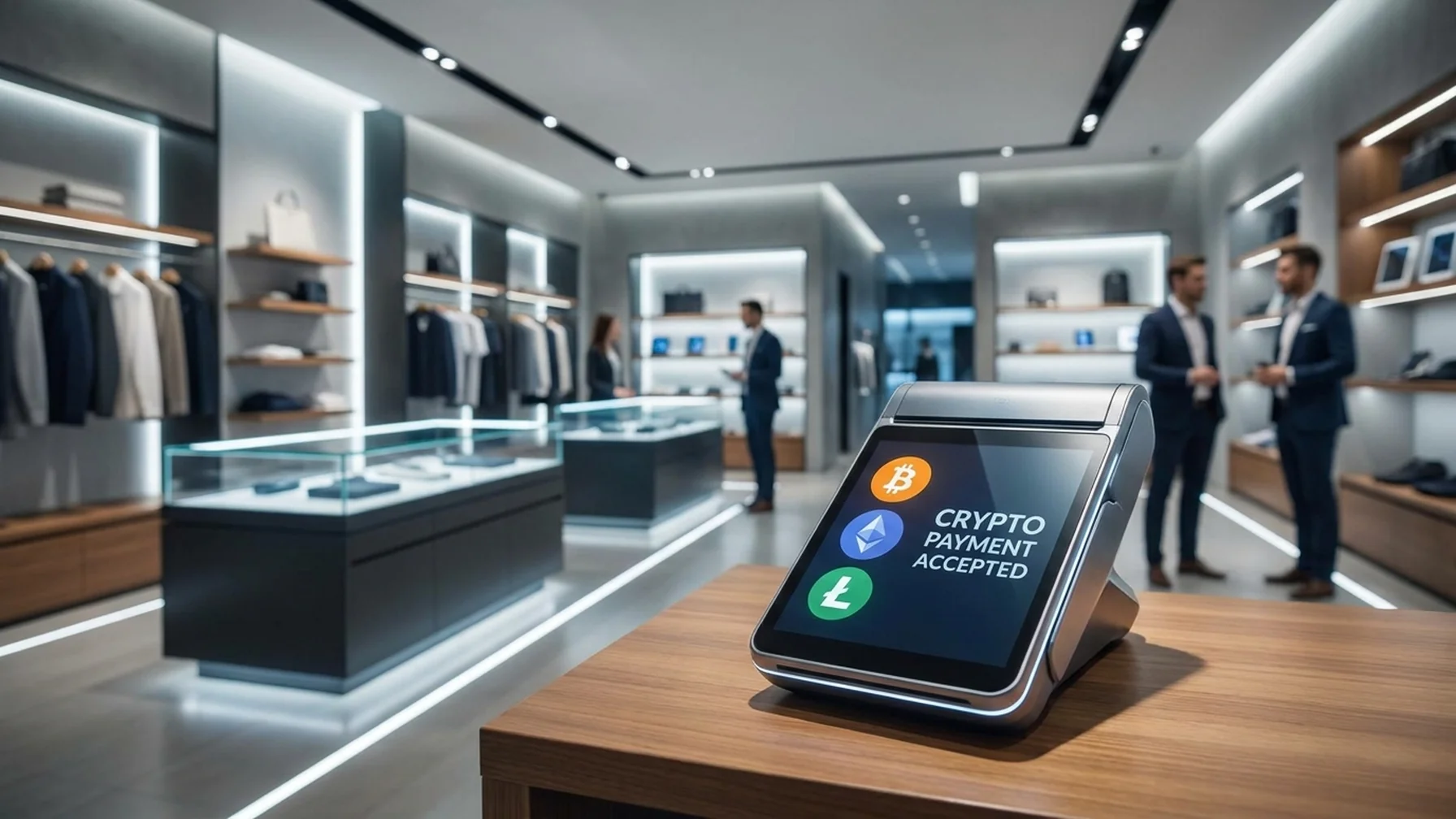
Exploring the Benefits of Crypto Point of Sale Integration
Contents

Walk into a coffee shop in Lisbon, a fashion boutique in Tokyo, or a hardware store in Buenos Aires, and there's a real chance you'll see the same little sign at the register: "We accept crypto." A decade ago that would have been a marketing stunt. Now it's increasingly a checkout option that customers actually use.
The reason isn't ideology. It's pragmatism. A crypto point of sale system gives retailers something they've been missing for years — a payment rail that doesn't bend the knee to card networks, banks, or cross-border friction. Whether that's worth the integration effort depends on the business. For more retailers than you'd think, it already is.
Payment flexibility — and why customers care
Customers value choice. That sounds obvious, but the data backs it up: cart abandonment in e-commerce often spikes when a buyer's preferred payment method isn't available. Adding cryptocurrency to the mix isn't going to triple your sales. It's a marginal lift. But the marginal lift compounds, especially in segments where crypto-native customers concentrate — tech, gaming, luxury goods, online services.
Picture a coffee shop in a tech-heavy neighborhood — the kind of place where half the clientele works at Web3 startups. Adding Bitcoin and Ethereum at checkout isn't a gimmick there. It's recognizing how that customer base actually moves money.
The benefits, side by side
Most articles on this topic stay vague. Here's what the actual benefits look like when you map them to real retail scenarios:
BenefitWhat it doesReal-world scenarioPayment flexibilityAdds new payment options at checkoutA coffee shop accepting BTC and ETH alongside cardsNew customer baseAttracts crypto-native and tech-forward buyersAn electronics retailer pulling in crypto-holding customersLower transaction costsCuts processing fees vs. credit cardsA small boutique saving 2–3% per transactionStronger securityReduces fraud and chargeback riskAn online store cutting chargeback lossesInternational salesSimplifies cross-border paymentsAn e-commerce site bypassing FX delaysOperational efficiencyFaster settlement, fewer middlemenA restaurant chain shaving seconds off checkoutBrand innovationSignals technical sophisticationA fashion brand attracting younger demographicsFuture readinessBuilds infrastructure for digital walletsA grocery store ready for stablecoin and CBDC adoption
None of these are revolutionary on their own. Stack them together, and the case starts to look different.
The numbers retailers actually care about
Let's talk about transaction fees, because this is where the real money lives. Credit card processing in the US typically runs 1.5–3.5% per transaction depending on the card network — Visa and Mastercard interchange plus the processor's markup. Amex tends to be higher. For a merchant doing $500K a year in card volume, that's $7,500 to $17,500 walking out the door annually, just to move the money.
Crypto payments through providers like BitPay, NOWPayments, or Coinbase Commerce typically charge 0.5–1% all-in. Some are even lower for high-volume merchants. The math gets interesting fast.
And then there are chargebacks. Card-based fraud chargebacks cost US merchants over $30 billion annually according to Visa's own data. Crypto transactions are technically irreversible — once confirmed on-chain, the payment is final. That cuts chargeback fraud to near zero. For online merchants in fraud-heavy categories like electronics or digital goods, this alone can justify the entire integration.
Attracting a different kind of customer
Crypto holders are not a monolith, but they share a few traits. They tend to skew younger. They tend to spend on tech, gaming, travel, and luxury. And they actively seek out merchants who accept their preferred payment method.
Coingecko estimates roughly 580 million people held some form of crypto by the end of 2024. Even if only a small fraction of them actively pay with it, that's a non-trivial customer pool. A crypto point of sale system signals to that pool that you're worth their attention.
What's interesting is the loyalty effect. Customers who can pay in their preferred way tend to come back. It's a small thing, but small things matter when retention is the whole game.
Security, but the real version
Here's where I'll push back on some of the marketing. Crypto payments are secure in specific ways — and not in others.
What blockchain genuinely gives you: cryptographic verification of payments, public audit trails, and immutability after settlement. A confirmed transaction can't be reversed by a customer claiming fraud. That's real. That's valuable.
What blockchain doesn't give you: protection from your own wallet getting compromised, insurance against your payment processor going down, or guarantees if you accept volatile coins and the price tanks before you convert. Security is a system. The blockchain is one component.
For most retailers, the practical answer is using a crypto POS provider that converts incoming payments to fiat instantly — BitPay does this, so does Coinbase Commerce. You get the fraud-resistance benefits without the volatility risk.
Cross-border sales — where crypto actually shines
If you sell internationally, this is probably the most important section. Cross-border payments are where traditional finance is at its worst. SWIFT transfers can take 3–5 business days. Currency conversion fees stack up. Some destinations are nearly impossible to reach reliably — anyone trying to receive payments from Argentina, Nigeria, or Pakistan knows what I mean.
Stablecoin payments — USDC, USDT — settle globally in minutes. No currency conversion. No correspondent bank delays. No mysterious fees that show up in the reconciliation report two weeks later.
For a SaaS company selling to global customers, or an e-commerce site with international shoppers, this isn't a small benefit. It's a structural advantage.
Operational efficiency — quieter, but real
Less third-party reliance means fewer moving parts. A direct on-chain payment doesn't go through a card network, an acquiring bank, an issuing bank, and a processor. It goes from wallet to wallet, with the POS provider handling settlement and reporting.
Fewer steps mean fewer points of failure. Faster reconciliation. Cleaner books. For a restaurant chain processing thousands of transactions a week, even small efficiency gains add up.
How not to mess up the integration
Most failed crypto POS rollouts don't fail because the technology was bad. They fail because the rollout was sloppy. Three things make the difference:
Train your staff. They'll be the ones helping customers who've never paid with crypto before. A confused cashier kills the experience faster than anything.
Keep your security current. Update your POS software. Use 2FA on the merchant dashboard. Don't reuse passwords across financial systems.
Communicate it. Signage at the register, a banner on the website, a social post. Customers can't use what they don't know is available.
Get those three right and the integration usually goes smoothly. Skip them and you'll spend more time troubleshooting than serving customers.
Brand image — the soft benefit that's harder to measure
Worth saying directly: accepting crypto positions you as a forward-looking business. That matters in some categories more than others. A fashion brand targeting Gen Z gets more mileage from this than a hardware store catering to retirees. Know your audience.
That said — being early in any payment trend tends to pay off later. Merchants who adopted contactless payments in 2017 looked ahead of the curve. The ones who waited until 2021 looked like they were catching up.
Where this is headed
Stablecoins moved roughly $27 trillion in transaction volume in 2024 according to Visa's on-chain dashboard, much of it real economic activity rather than trading. CBDCs — central bank digital currencies — are in pilot or live in over a hundred countries. The infrastructure for digital payments is being built whether retailers participate or not.
A crypto point of sale system today isn't just about accepting Bitcoin from enthusiasts. It's about being plugged into the rails that will increasingly carry mainstream money over the next decade. Stablecoin payments alone are already a meaningful share of cross-border B2B settlement.
So is integration urgent for every retailer? No. A neighborhood dry cleaner probably doesn't need this in 2026. But for any business with online sales, international customers, or a younger demographic — it's no longer a question of whether, only when. The retailers thinking about it now are setting themselves up for the next phase. The ones waiting will catch up later, on someone else's terms.